

Lincoln Center Breaks Ground to Transform Its West Side, Increasing Welcome and Access to Campus
The Baron Theater and Stavros Niarchos Foundation (SNF) Gardens
Anchor Project in Recognition of Major Gifts
Design by Hood Design Studio, WEISS/MANFREDI, and Moody Nolan
Incorporates Feedback from Thousands of Community Members
Opening Summer 2028, Part of the
Stavros Niarchos Foundation (SNF) Lincoln Center West Initiative
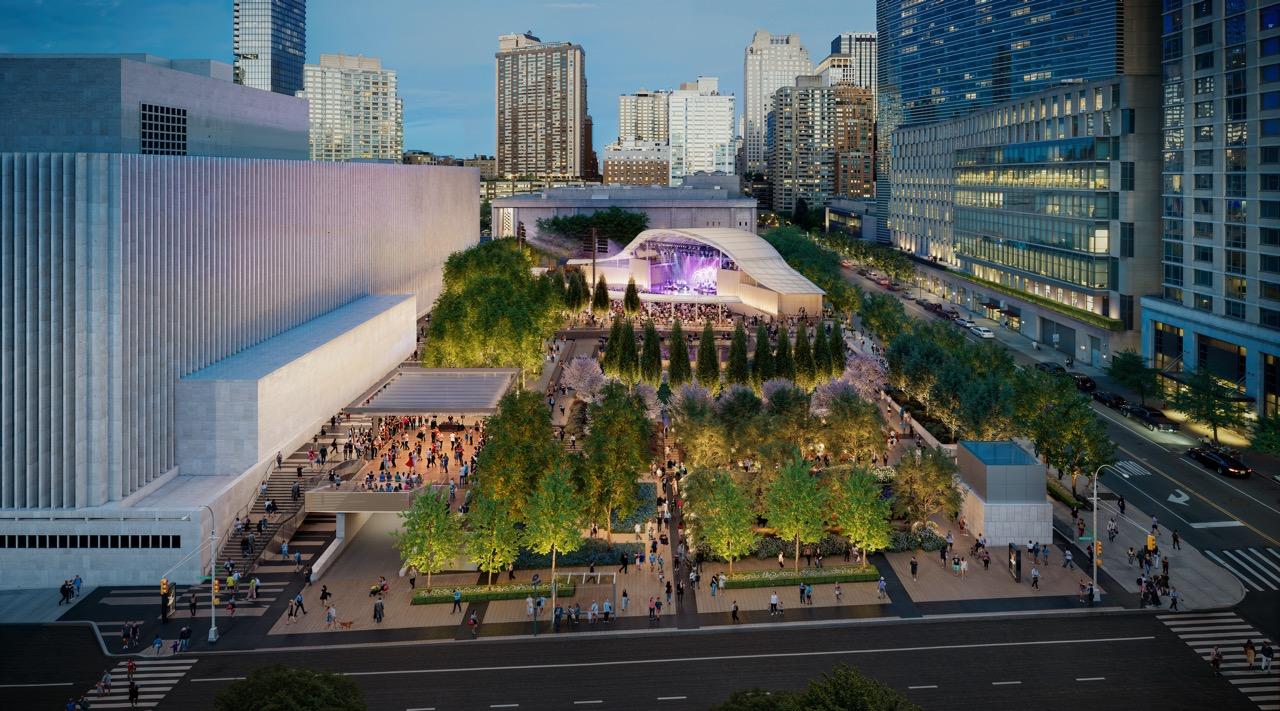
Aerial view from Amsterdam Avenue looking east. Rendering by Brooklyn Digital Foundry.
NEW YORK, NY (May 11, 2026) — Today, Lincoln Center for the Performing Arts (LCPA) held a groundbreaking ceremony as the institution reimagines the west side of its campus, creating new spaces to advance the arts as a force for inspiration and connection for all. Lincoln Center will build a new, 2000-person venue named The Baron Theater, in recognition of donor, The Baron Family Foundation, founded by Judy and Ron Baron. The Theater will be a centerpiece of the new Stavros Niarchos Foundation (SNF) Gardens and the newest performance space at Lincoln Center. The design incorporates input from thousands of community members, part of a robust participatory process. Imagery and video of the project, and from today’s ceremony, are here.
The Baron Family Foundation made a transformative $75 million gift that honors the rich artistic traditions of New York City and invests in their future on Lincoln Center’s campus. Mr. Baron has hosted his company’s Annual Baron Investment Conference at Lincoln Center since 2004. In recognition of this gift, the world-class amphitheater, for approximately 2000 audience members and designed by WEISS/MANFREDI, will be named The Baron Theater. The Stavros Niarchos Foundation (SNF) is a Founding Partner of the overall initiative to redesign Lincoln Center’s west face. SNF’s catalytic $75 million grant has also supported community engagement initiatives, projects that animated outdoor spaces during the pandemic, free programming throughout Summer for the City, and the ongoing Legacies of San Juan Hill initiative. In recognition of their support, the new performance gardens at Damrosch Park — home to The Baron Theater, as well as gardens, groves, a new water feature, and gathering spaces — will be named the Stavros Niarchos Foundation (SNF) Gardens.
“The theme of Baron Capital’s 33rd annual conference this fall, that will be again held at Lincoln Center’s Metropolitan Opera House, is ‘1982.’ That is the year we founded Baron Capital. Baron Capital’s mission is to ‘Change Lives’ of our clients and employees. It’s always been about the impact we have on others’ lives, just like The Baron Theater in the Stavros Niarchos Foundation (SNF) Gardens is intended to bring art and beauty to the city we love,” said Ron Baron, Co-Founder and President of the Baron Family Foundation. “We are honored that Lincoln Center and New York City have allowed my family’s foundation to make a naming gift to build The Baron Theater. New York City and Lincoln Center, where we have held Baron Capital’s annual meeting for 22 years, have changed our lives. Our gift is intended to be a token of our appreciation.”
“We are honored and very happy to be able to contribute—as our founder did in the institution’s earliest years — to a generational change at Lincoln Center, a new beginning delivering a more engaging, more open, more all-embracing public space,” said Andreas Dracopoulos, Co-President of Stavros Niarchos Foundation (SNF). “We’re proud to be a Founding Partner in this very important initiative, and we can’t wait to share in the joy and delight New Yorkers and visitors from around the world will take in the reimagined campus."
"The arts shape the character and vitality of cities, and we are committed to contributing to a more expansive and inclusive future for all New Yorkers. The west side of Lincoln Center's campus has, for too long, sent a message of exclusion—but today, we are proud to break ground on a project that will change that. No matter where you enter the campus, you will be greeted with the sense of open welcome and possibility that arts and culture should offer for all. The construction around us today is temporary. The invitation to join us here on this incredible campus is permanent,” said Mariko Silver, President and CEO of Lincoln Center for the Performing Arts.
The capital campaign’s $335 million goal to support the construction phase of the Initiative has been raised, thanks to the generosity of foundations, private donors, the LCPA Board of Directors, and public support from the State and City of New York. Today, the campaign continues on to support a robust lineup of free performances, including during the Summer for the City festival, for generations to come.
"New Yorkers have rallied around this Initiative with incredible generosity,” said Steven R. Swartz, Chair of the Board of Directors of Lincoln Center for the Performing Arts. “Donors, artists, neighbors, students, staff — truly, New Yorkers from all walks of life — have been moved by the vision of a more welcoming Lincoln Center that offers new spaces for anyone to experience the arts in their daily lives. With this incredible support, we will deliver performance gardens that are spaces of welcome, of calm, and of art for generations to come.”
LCPA is grateful to the many individual donors, foundations, and corporations who have given so generously to support this important project for the city of New York.
The Baron Family Foundation • Stavros Niarchos Foundation (SNF)
The Starr Foundation • John and Susan Hess • The Tow Foundation
Bloomberg Philanthropies • Advance Knowledge / Morwin Schmookler •
Sheryl and Chip Kaye • William Randolph Hearst Foundation
Arison Arts Foundation • Kathryn and Kenneth Chenault •
Katherine G. Farley and Jerry I. Speyer • Kim and Jeff Greenberg •
Cynthia and Anthony Kim • Jill and Bobby Le Blanc • Mazumdar Shaw Philanthropy • Barbara and John Vogelstein
Hearst • Morgan Stanley • Jeff Gates and Mike Moran •
Frank A. Bennack, Jr. and Mary Lake Polan • Meg and Bennett Goodman •
David and Susan Rockefeller • Tina and Steven Swartz
The Lazarus Family • Brad S. Karp, Paul, Weiss, Rifkind, Wharton & Garrison •
Shari and Jeff Aronson • Jacqueline Bradley and Clarence Otis, Jr. •
Anne and Joel Ehrenkranz • Mary Ann Tighe and Dr. David Hidalgo •
The Hoglund Family, in memory of Suzanne Hoglund
Earlier this spring, as fencing went up to prep the site for construction, LCPA unveiled The Future We Create, a mural by lead artist Vanesa Álvarez and assistant artist Derval Fairweather. In collaboration with the public art nonprofit ArtBridge, the mural is a cornerstone of the participatory planning process that engaged local residents, NYCHA neighbors, students, and community stakeholders. A series of workshops and conversations led by Álvarez helped shape the themes and imagery reflected in the final design, which depicts historic figures from the neighborhood—including James P. Johnson, Thelonious Monk, Mary White Ovington, Arturo Alfonso Schomburg, and others—alongside current residents. The mural is on view along Amsterdam and 62nd Street. Imagery and video of the artwork is available here.
This project is being undertaken in coordination with NYC Parks and NYC Department of Transportation. Damrosch Park is mapped city parkland maintained and operated by LCPA.
Groundbreaking Ceremony
Community leaders, artists, donors, leadership from across Lincoln Center, and many more were in attendance for today’s ceremony.
The ceremony featured performances that celebrated the cultural legacy of the area throughout history, including the artistry that flourished historically in the San Juan Hill neighborhood and that continues to influence artists innovating today. Looking ahead to the future, performances were offered from artists with ties across the Lincoln Center campus.
The program opened with a newly commissioned poem, The Future We Create, by Poet-in-Residence Mahogany L. Browne, co-written with emerging artist and oral historian Oshun Baronville and performed by both artists. The poem shares the same title as the new mural by Vanesa Álvarez and Derval Fairweather that adorns the construction fencing along 62nd and Amsterdam Avenue.
Grammy-nominated jazz pianist and composer Sean Mason played "Thelonious," written by Thelonious Monk, as a tribute to the neighborhood of San Juan Hill, where the great composer lived most of his life and drew inspiration for his musical inventions.
A cast of ten dancers from the School of American Ballet performed an exuberant excerpt from George Balanchine's Cortège Hongrois, a work he originally created for New York City Ballet in 1973.
New York City Ballet dancers Harrison Coll and Peter Walker performed an excerpt from The Times Are Racing, choreographed by NYCB Resident Choreographer Justin Peck and set to an electronic score by acclaimed composer and electronic artist Dan Deacon.
World-renowned vocalist Catherine Russell joined Sean Mason and brought timeless jazz and rich vocals to close out the program with Manhattan by Richard Rodgers and Lorenz Hart.
"This groundbreaking marks the third major redevelopment at Lincoln Center, each one designed to make our campus more open and inviting. We are so grateful to our extraordinary design team, and to the thousands of neighbors who have helped us shape the project to best serve the needs of our community,” said Katherine Farley, Chair Emeritus of the Board of Directors of Lincoln Center for the Performing Arts.
“It is with deep gratitude that we mark today’s groundbreaking of a more vibrant and welcoming west side of our campus,” said Robert K. Steel, Vice Chair and Member of the Board of Directors of Lincoln Center for the Performing Arts. “We are proud to serve this great city and we celebrate this milestone alongside our neighbors, supporters, and all New Yorkers.”
“It is so important that everyone have access to spaces where community is celebrated and individual talent is discovered and nurtured,” said Misty Copeland, dancer and member of the Board of Directors of Lincoln Center for the Performing Arts. “The arts can provide these spaces for so many of us. We are thrilled to break ground today to create spaces that will welcome future generations to experience the power of the incredible artistry across this great campus.”
“It is with great excitement and full hearts that we dream alongside so many New Yorkers today about the incredible art that will animate these spaces for future generations,” said Shanta Thake, Ehrenkranz Chief Artistic Officer of Lincoln Center for the Performing Arts. “Performances and creativity from across Lincoln Center and beyond will have a home here. We are so grateful for the deep collaboration that has brought us to this moment today and look forward to the future together."
"The Damrosch Park portion of the SNF Lincoln Center West Initiative project will be a welcoming, accessible, green space for residents in NY-12 to relax, play, and perform throughout every season," said Representative Jerrold Nadler (NY-12). "This project breaks down barriers that have obstructed our community for far too long and finally welcomes our neighbors residing in the Amsterdam Houses to Lincoln Center. The new design integrates Damrosch Park with its surrounding areas, so every neighbor can enjoy the multi-use park and its many resources. I am pleased that public art will honor the legacy of the San Juan Hill neighborhood and that the heart of the park as a historic space for performance has been maintained. The new design of Damrosch Park reflects the needs and desires of New Yorkers, and I am thrilled for this new chapter in our community."
“Lincoln Center is one of the world's premier cultural destinations, and this project will ensure it remains a place where every New Yorker feels welcome," Governor Kathy Hochul said. "By investing in this transformative redevelopment, we're opening up world-class arts and performance spaces to the surrounding community, creating new opportunities for free programming, and ensuring that the next generation of New Yorkers can experience the power of the arts right in their own neighborhood."
“Lincoln Center has always been a cultural anchor for New York, and the transformation of this park into new performance gardens is an important investment in the West Side and the city as a whole. This project will help better connect residents of Amsterdam Houses and surrounding communities to the Lincoln Center campus, turning what can feel like separate spaces into one shared civic and cultural landscape. By expanding accessible public space for performance and gathering, it strengthens neighborhood ties, broadens access to the arts, and ensures that world-class culture is part of everyday life for all New Yorkers,” said NYS Senator Erik Bottcher.
"Say goodbye to the era of Robert Moses, and say hello to a brand new, inclusive Lincoln Center,” said Assemblymember Linda B. Rosenthal (D/WF-Manhattan), Chair of the Assembly Committee on Housing. “I am extremely proud to have secured state funding for this critical community initiative, and with this groundbreaking, Lincoln Center makes clear that every West Side neighbor should have a front row seat to the magic and beauty that pervades its campus. I look forward to celebrating the finished project, and I am grateful to Lincoln Center for all that it has done to honor the history of the San Juan community and our West Side neighbors.”
"My administration is proud to invest in Damrosch Park at Lincoln Center to grow new green gardens, build a place where neighborhood kids can actually run and play, and create a world-class amphitheater that powers Lincoln Center's free Summer for the City programming for everyone," said Mayor Zohran Kwame Mamdani. "That's what it looks like when we choose a city that works for working people: places that are open, welcoming, and alive — where you can sit down without spending money, watch world-class performances, and spend time with your fellow New Yorkers in the heart of the greatest city on earth.”
“Supporting the arts and expanding access to our cultural institutions is central to building a more inclusive New York City,” said New York City Council Speaker Julie Menin. "Lincoln Center’s transformation will break down barriers, create an even more welcoming public space, and ensure that this campus serves and reflects the full diversity of our city. I applaud Lincoln Center for its leadership in making the arts more accessible to all New Yorkers.”
“Today’s groundbreaking marks an exciting new chapter for Lincoln Center for the Performing Arts and for all New Yorkers who cherish it. The Stavros Niarchos Foundation (SNF) Lincoln Center West Initiative will transform this iconic campus into a more open, welcoming, and accessible space by breaking down barriers and creating new opportunities for communities across Manhattan to gather, connect, and experience the arts. I’m grateful to the Stavros Niarchos Foundation, the Baron Family Foundation, Lincoln Center President & CEO Dr. Mariko Silver and the many partners whose leadership and generosity made this investment possible,” said Manhattan Borough President Brad Hoylman-Sigal.
“The SNF Lincoln Center West Initiative is a major investment in making Lincoln Center more open, accessible, and connected to the surrounding community. Removing barriers, adding green space, and creating improved places people can use will make a real difference for neighbors, students, and families here every day,” said NYC Council Member Gale A. Brewer. “What stands out is the extent of the community input that shaped this design, from public meetings to ongoing engagement with neighbors. That matters, especially for a campus in the middle of a residential neighborhood and near many schools. A commitment to free programming, better access, and a park that works year-round is exactly what we should be doing with our public spaces.”
"Damrosch Park has always been a vital green sanctuary for the Upper West Side, and this transformation will ensure it remains a world-class destination that is more accessible and welcoming than ever before,” said NYC Parks Commissioner Tricia Shimamura. “By integrating the new Baron Theater within the reimagined Stavros Niarchos Foundation Gardens, we are proving that parkland can be both a peaceful retreat and a vibrant cultural mechanism. We are excited to partner with Lincoln Center on a design that reflects the voices of thousands of New Yorkers, creating a resilient and inclusive landscape where the arts and the outdoors are open to everyone."
“With this bold plan built from community voices, Lincoln Center's redesign of the west side of their campus will create a new space in our city for people to rest, to enjoy friends and family, and to experience the power of performance, for free," said NYC Cultural Affairs Commissioner Diya Vij. “The city is proud of its support for this project, which will foster a more open, welcoming campus for all New Yorkers and strengthen the institution's bonds with its neighbors.”
“The Public Design Commission’s mission of promoting excellence in design compels us to ask how our public spaces can better serve our communities. The transformation of Damrosch Park is a testament to the City's commitment to an equitable public realm that engages and welcomes our neighbors from NYCHA Amsterdam Houses and youth from the surrounding public schools. This work will provide critical public space and programming that delivers arts and culture for all—honoring the legacy of San Juan Hill and the influential artists that inspired the neighborhood, the City, and beyond,” said Erich Paul Bilal, Executive Director, Public Design Commission.
“Extensive neighborhood engagement made this project stronger at every step, from design to delivery. We appreciate Lincoln Center's openness and commitment to including our Upper West Side community throughout the review process. Our community board voted unanimously to support the new design. We believe Damrosch Park will emerge not just as a renewed civic space, but as a model for how public projects can be shaped through sustained community partnership,” said Alex Bell, Manhattan Community Board 7 Chair.
“Our community is filled with older adults, teens, and young children that will be served by these new gardens and free access to performances for years to come. We are working with Lincoln Center to create real change where residents feel the campus is a place for them. Throughout the process, it was clear Lincoln Center wanted to hear from the Amsterdam Houses community. Residents were given the time, support, and space for meaningful conversations, leading to real results. What’s being built here is a better future for all, reflecting the pride, culture, and needs of the families who call this neighborhood home,” said Yvette Powell, Tenant Association President of Amsterdam Houses (NYCHA).
“Too often, development happens to communities, not with them. The way Lincoln Center worked with us changed our relationship. This groundbreaking represents trust built over time and a park that our residents from Amsterdam Addition— from the children to the seniors— will use because they were part of the re-design from day one,” said Patricia Ryan, Tenant Association President of Amsterdam Addition (NYCHA).
“Finally the wall is coming down. This moment has been a long time coming. Being part of the planning process showed us that our experiences matter and that this space should reflect the people who use it every day. Today’s groundbreaking is proof that our voices were heard. From here, we begin building a new future together, brick by brick, flower by flower. This is a new day, one we’ve been welcomed in, and where we will continue to show up and belong,” said Maria Guzman, Tenant Association President of Harborview Terrace (NYCHA).
“For the past three years, I’ve shared my opinion, my voice, and perspective as a blind community member who cares deeply about the new construction and its accessible features. Having been a part of the design planning effort, I am looking forward to feeling, smelling, and experiencing the new space that welcomes guests of all abilities,” said Kiana V. Glanton, Development and Special Projects Manager at Lighthouse Guild.
"Fordham University is excited to see Lincoln Center’s visionary initiative come to life! The Stavros Niarchos Foundation Lincoln Center West Initiative will transform their campus into a welcoming urban oasis that all New Yorkers can be inspired by and enjoy. This is a truly extraordinary project and we applaud Dr. Mariko Silver for her leadership and Lincoln Center’s commitment to community,” said Travis Proulx, Vice President of External Affairs, Fordham University.
Design For Greater Access and Welcome
Opening Up to Amsterdam Avenue
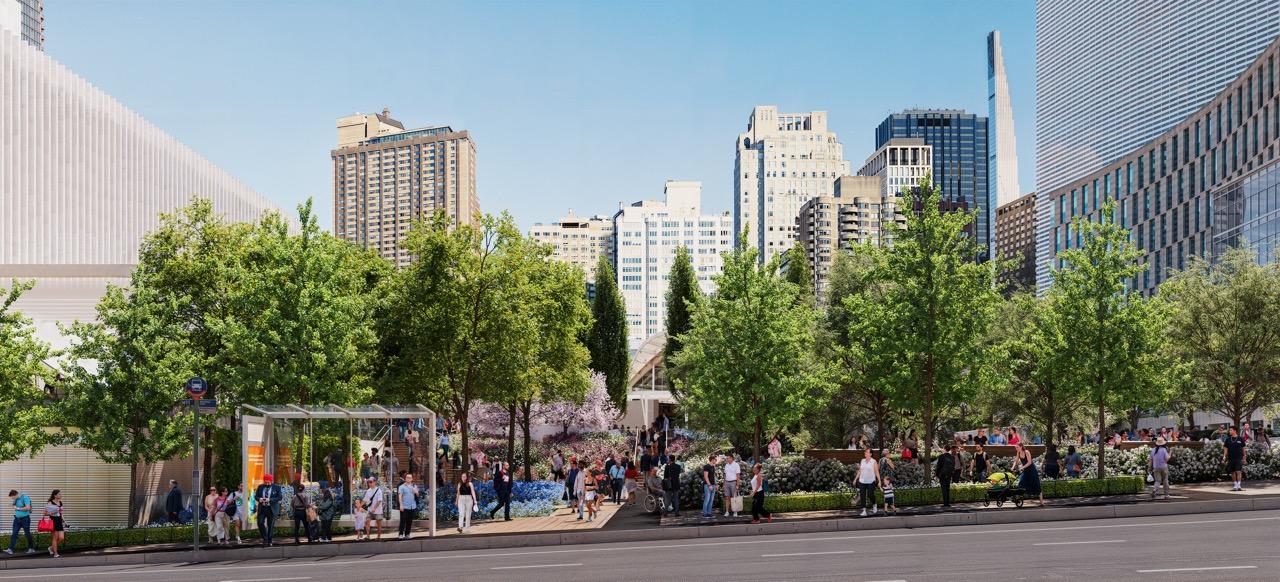
View from Amsterdam Avenue. Rendering by Brooklyn Digital Foundry.
The new design eliminates the visual and physical barrier wall at Damrosch Park to create a more welcoming edge to the campus, to better serve close neighbors including residents of New York City Housing Authority developments at Amsterdam Houses and Addition, students of Fiorello H. LaGuardia High School of Music & Art and Performing Arts, and the five high schools at the Martin Luther King, Jr. Educational Campus.
Developed with input from NYC Parks, the design for the Stavros Niarchos Foundation (SNF) Gardens prioritizes places for community use and relaxation and seamlessly opens to the rest of the campus.
Drawing inspiration from Lincoln Center’s Modernist architecture and landscape architecture, the design acknowledges the original campus’ symmetrical layout and formal edges by retaining a strong central axis and formal entry points, while introducing and sensitively integrating contemporary elements that center accessibility, flexibility of use, and a variety of programmatic needs. The new design also incorporates materials, textures, colors, and scale of design elements found across the rest of Lincoln Center to create cohesion across campus.
Features of the reimagined entrances to the campus include:
- Sidewalk improvements, including an improved bus waiting area, an expanded sidewalk between 62nd and 65th Streets, increased greenery and shade along this edge, and more benches and lighting for an enhanced pedestrian experience
- A series of groves and green spaces at the new west entrances, with a variety of spaces to sit, relax, and meet friends right at street level
- Accessible pathways from multiple entry points and circulation throughout the space, with inclusively designed wayfinding guided by the Institute for Human-Centered Design (IHCD)
- Interventions within the concourse connecting Amsterdam Avenue to the 1 train subway entrance on Broadway (additional details to be announced)
- New opportunities for seating at the West 65th Street corner of campus, where hundreds of area high school students engage with Lincoln Center every day (additional details to be announced)
Groves and Green Spaces
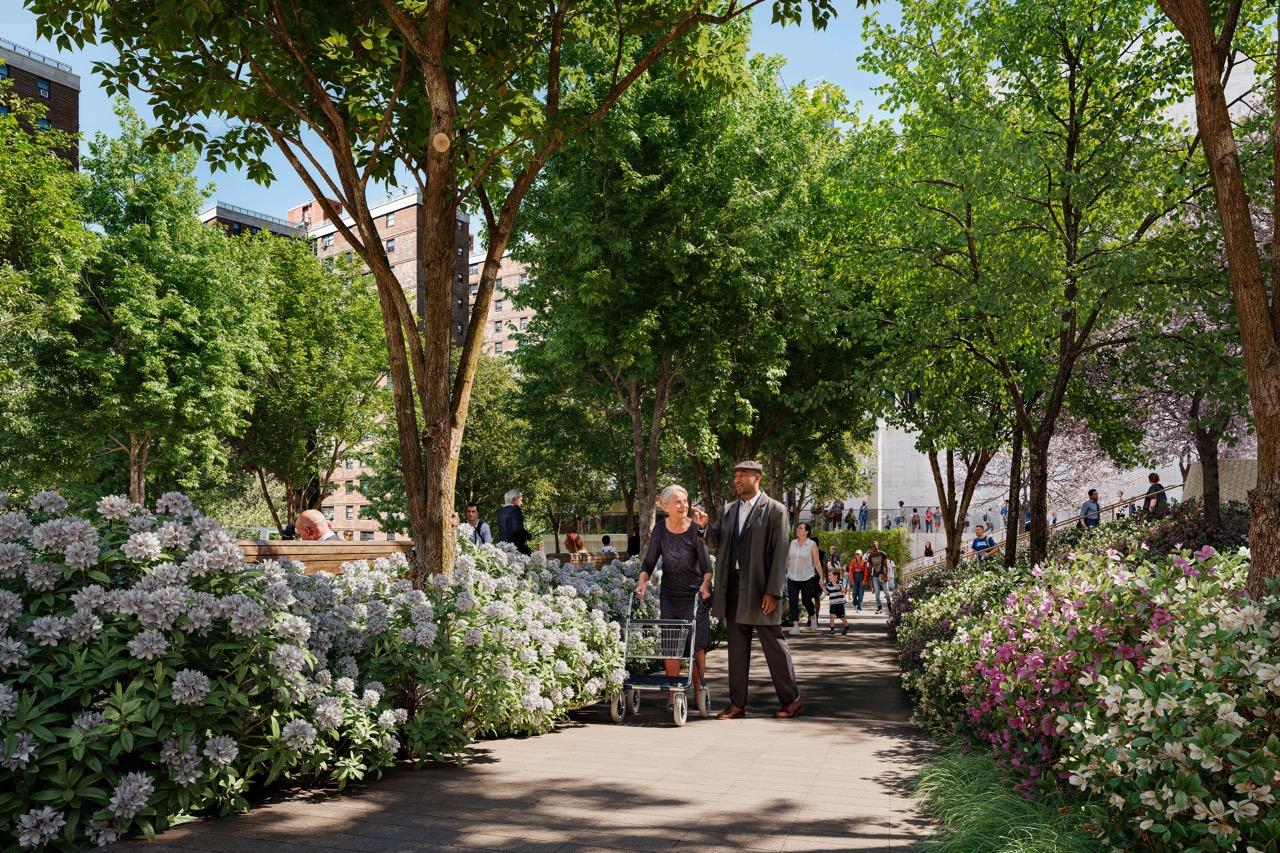
View of groves looking northwest. Rendering by Brooklyn Digital Foundry.
Throughout the participatory planning process, community members shared their desire for the spaces adjacent to Amsterdam Avenue to be flexible, graceful, and inviting. New Yorkers from around the neighborhood and the city also felt strongly that the park should prioritize greenery, a water feature, increased shade, and sustainability—including 50% more trees than currently exist in the park—and inclusive design for people with disabilities.
Improvements include multiple different types of community spaces organized around an interactive water feature and expansive lawn, including large groves of trees providing shade and flowering gardens. Each of the spaces offer a variety of seating options, shade, and plantings. Many of the geometries in the new park echo historic geometries of Lincoln Center. For instance, the new lawn evokes the shape and scale of the bandshell but re-interprets it as a space for community activity, rather than a physical barrier.
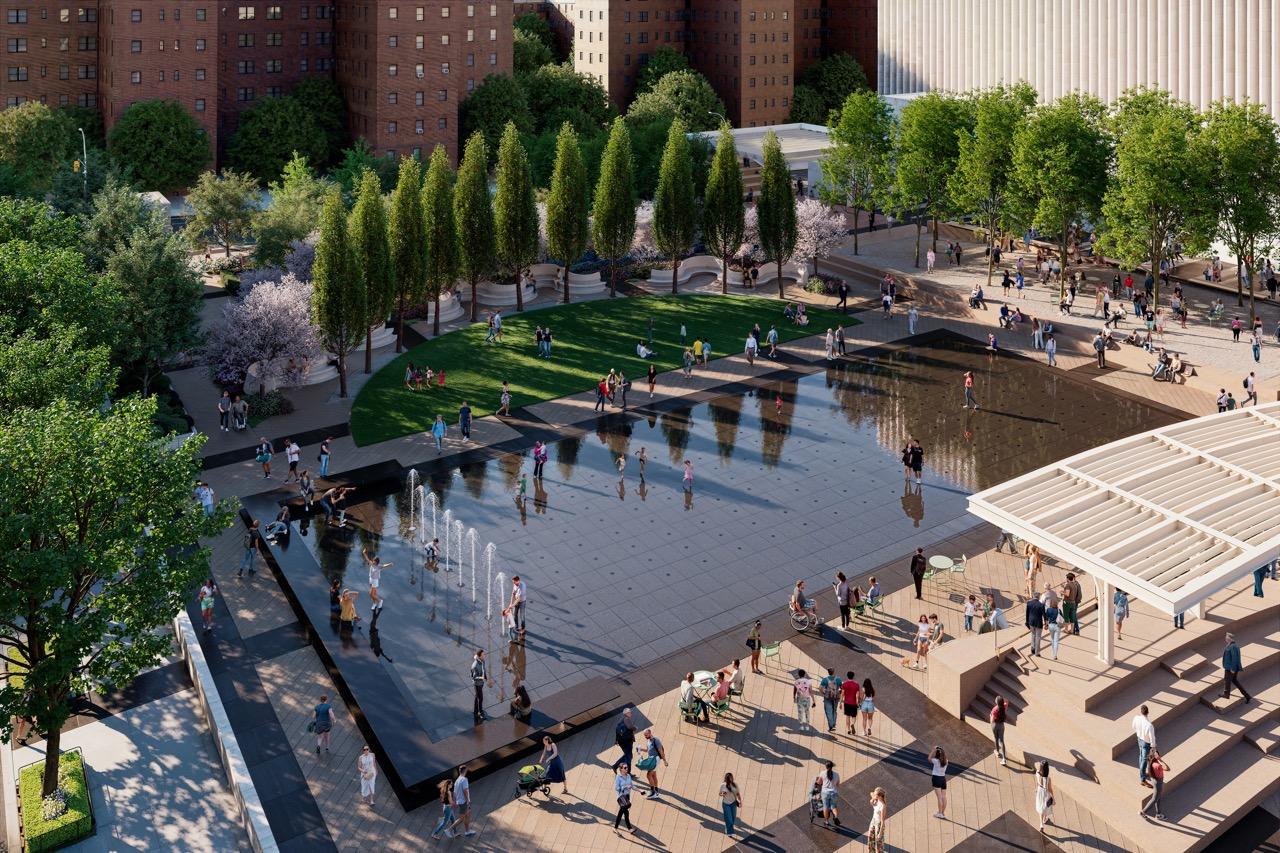
Aerial view looking west. Rendering by Brooklyn Digital Foundry.
“To open this edge of Lincoln Center is to restore the civic soul, transforming a boundary in a threshold of belonging. Where a wall once stood, gardens and groves now bloom, weaving the public into the landscape. Here, the memory of San Juan Hill meets the future of the city, allowing visitors to look back with respect and forward with hope. This is not just a change of scenery, it is an invitation to see yourself in the heart of New York, and to find a garden that is finally yours,” said Walter Hood, Creative Director and Founder, Hood Design Studio.
Features of the new groves and green spaces include:
- A welcoming green space surrounded by flowering trees and a serpentine bench with seating facing both west towards Amsterdam Avenue and east towards the water feature and The Baron Theater
- The Starr Foundation Fountain—a water feature animated by mist, water jets, and reflection, which will be a community resource for relaxation and play
- Groves with spaces for sitting, gathering, and resting under the shade of large trees, prioritizing native plantings and a mix of annual and perennial, blooming flowers, and deciduous trees
- The Kaye Family Terrace, a welcoming space along the Amsterdam Avenue entrance that will be directly connected to numerous performance spaces, lawns, and more
The new design prioritizes sustainability, incorporating climate responsive elements, including:
- On-site stormwater management that will capture and clean rainwater before it goes into NYC sewers, so fewer pollutants flow into nearby waterways
- Materials with low embodied carbon, light colors, and passive ventilation will be utilized to minimize climate impact
- Native plantings, and an increase in the total number of trees by 50%
Performance Spaces
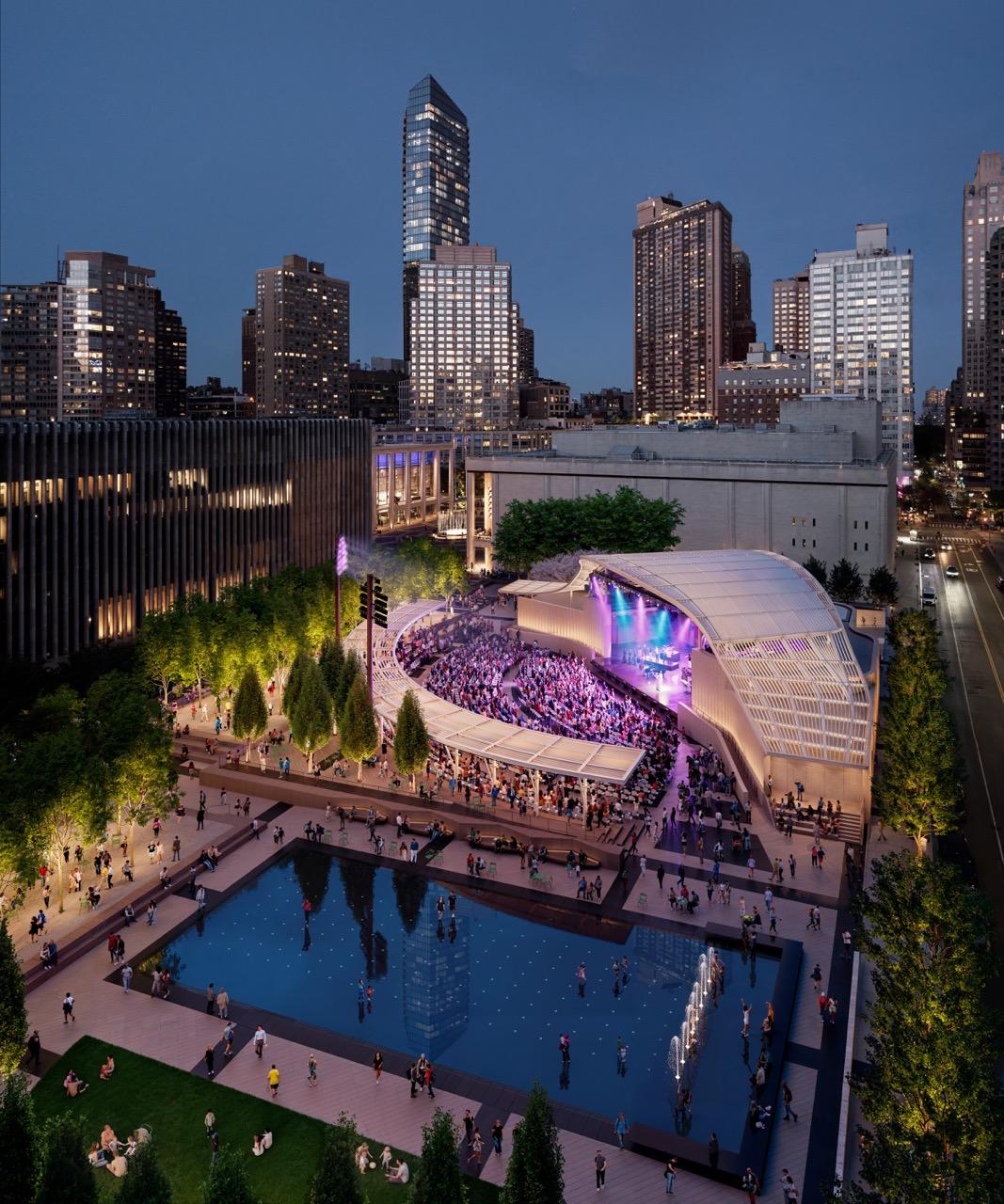
Aerial view looking east. Rendering by Brooklyn Digital Foundry.
In community workshops, participants emphasized the importance of maintaining the site’s primary and historic use as a performance park. It has been an essential space for free, non-ticket holding public access since its inception. But, for the majority of the year, the predominantly hardscaped space is cut off from the community with limited green space and seating. This design reimagines the relationship between the theatrical and recreational spaces and will allow for more of the space to be used year-round and support a variety of events and flexible uses.
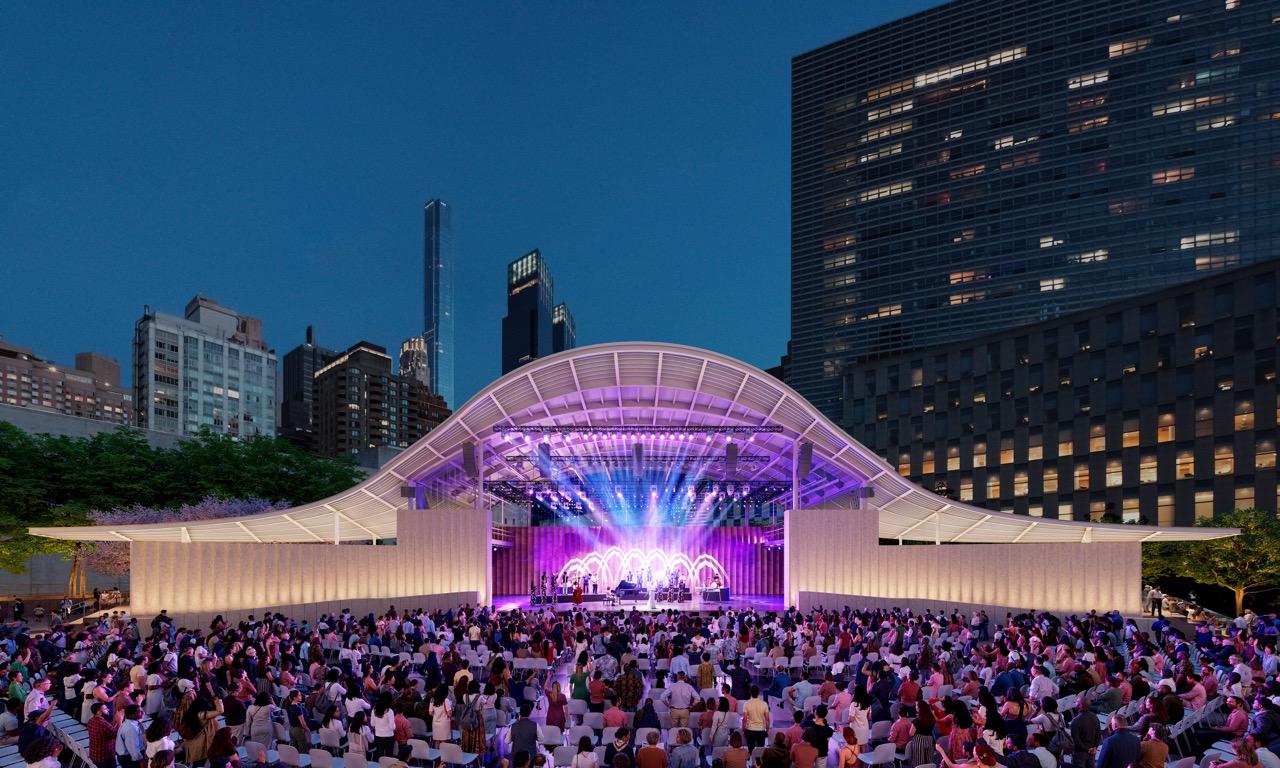
View of The Baron Theater during performance. Rendering by Brooklyn Digital Foundry.
The Baron Theater—a new permanent theater structure—will anchor the space to meet artistic and community needs. The Theater faces an inviting, open plaza for audience seating of up to approx. 2,000.
The location and design of The Baron Theater maintain the historic vista from Josie Robertson Plaza and realize the original intent of a theater in a park, by surrounding the new architecture with a grove of trees following the original grid design of the park.
The new size, orientation, and design of the stage, along with technological and infrastructural improvements, will greatly improve the artist and audience experience and mitigate sound impact outside the venue as it welcomes dance, theater, and music from around the world.
Even when the seating area is not set for performances, the plaza serves as a welcoming recreation destination, activated by flexible seating.
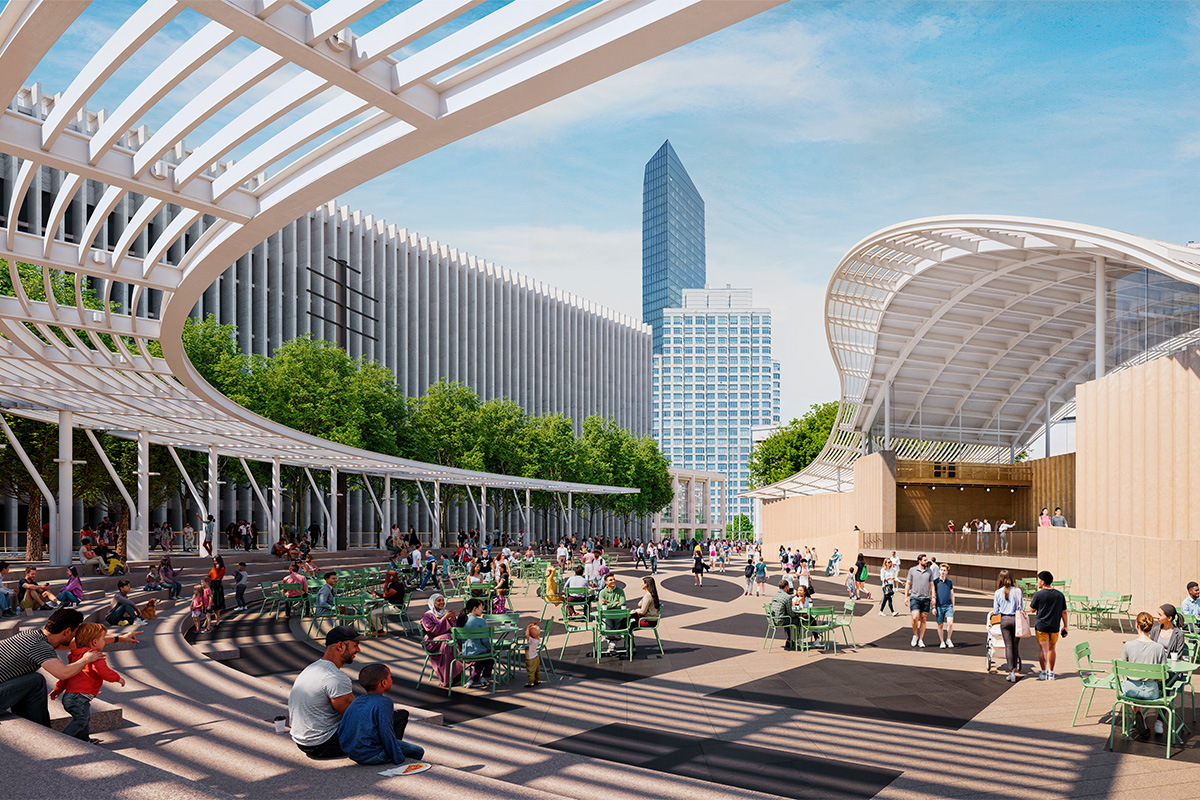
View of The Baron Theater, daytime. Rendering by Brooklyn Digital Foundry.
“We’re thrilled to design Lincoln Center’s first freestanding theater in over 50 years; a theater in the park. This groundbreaking milestone signals a renewed commitment to bring music and performance into the heart of the community,” said Marion Weiss and Michael Manfredi. “The Baron Theater and its plaza are designed as an open invitation to gather, connect, and experience art. The silhouette of the theatre’sgently vaulted roof, paired with the sweeping arc of the trellis and tiered steps frame a welcoming setting for informal gatherings and the world-class productions for which Lincoln Center is renowned.”
The performance spaces include:
- The Baron Theater, a state-of-the-art amphitheater that will host free performances for an audience of up to approx. 2,000, oriented to bring audiences closer to performances and allow for use of the groves and green spaces during shows
- The John and Susan Hess Family Plaza, an open space in front of the amphitheater that is accessible to the public during non-performance times
- Flexible space adjacent to The Baron Theater’s backstage that can be used for food and beverage during performances, and the ability to accommodate smaller-scale programming when the main stage is not in use
- The William Randolph Hearst Foundation Overlook, a shaded overlook and grove with tiered seating for improved sightlines during performances, and activation by the community outside of the performance season
- The Len Tow Community Stage, a performance area within the groves where performances and family programming will be created by and for the community
- Public restrooms and water fountains
“Creating a more inclusive Lincoln Center starts with a clear and compelling vision, brought to life through the built environment,” said Jonathan Moody, CEO of Moody Nolan. “Our work on the Stavros Niarchos Foundation (SNF) Lincoln Center West Initiative has centered on creating a campus that is open, accessible, and welcoming to a diverse community— ensuring more people can see themselves reflected in and connected to the campus.”
A Robust Participatory Design Process
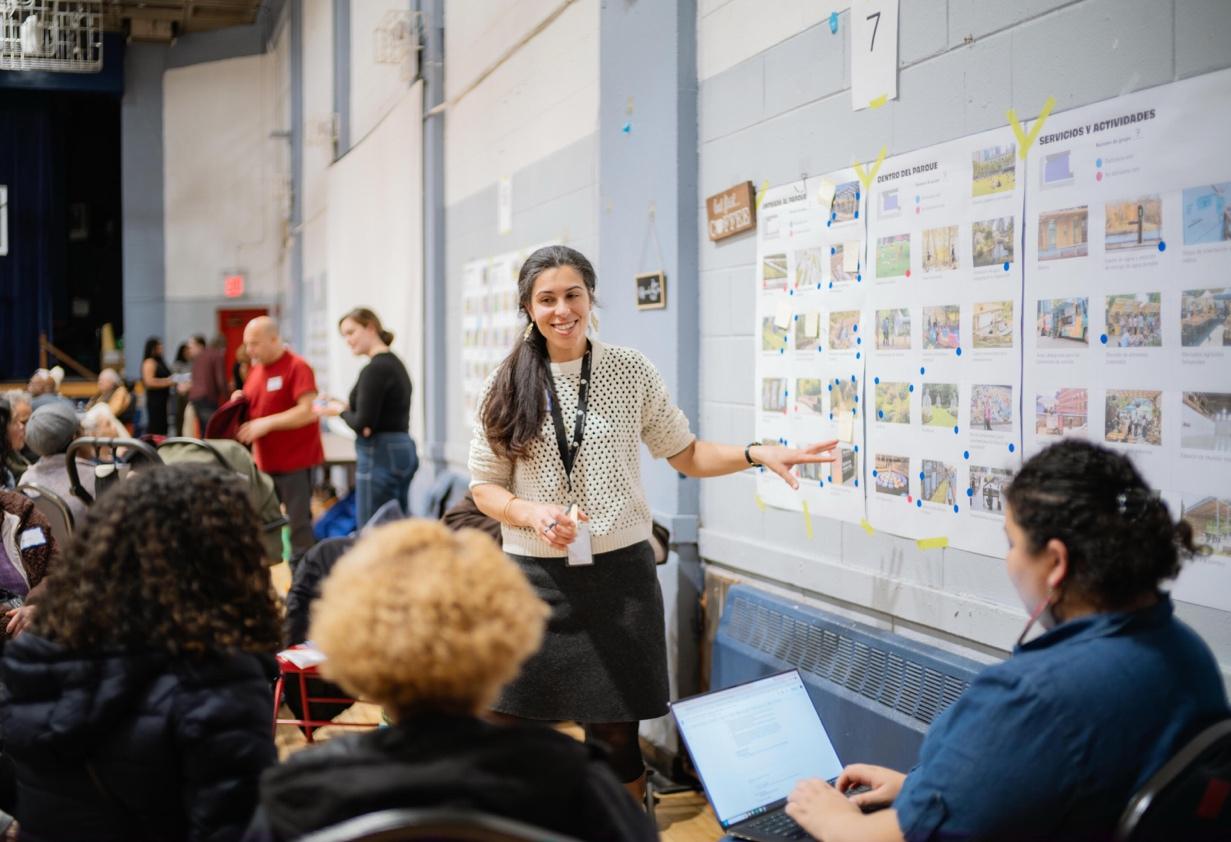
Participatory Planning Event at Lincoln Square Neighborhood Center, Dec ‘23. Photo by Lawrence Sumulong.
Throughout conceptualization and design, LCPA and its consultants have engaged thousands of New Yorkers through one-on-one interviews, focus groups, paper and online surveys, pop-up events, and workshops. These conversations have brought together neighbors, nearby NYCHA residents, advocates, community groups, staff and students from nearby educational institutions, elected officials, civic leaders, and other members of the New York City community, who shared their ideas, interests, questions, and feedback about the campus. This feedback shaped the design that will be realized.
This work included:
- 3,500+ survey responses, which gathered information from stakeholders, Lincoln Center audiences, and campus visitors about the wall along Amsterdam Avenue, the design of Damrosch Park, and the uses (both actual and desired) of the park and the campus' outdoor spaces
- 40+ pop-up events reaching 1,600+ people
- 13 community workshops attended by 800+ participants, in which stakeholders offered design ideas, reflections on access, and posed invaluable questions about the future of the campus
- 13 focus groups attended by 100+ participants, including community stakeholders, preservation and design experts, disability advocates, seniors, NYCHA residents, community organizations, school leadership, and members of Community Board 7. These focus groups took place over the course of three years to ensure the ideas heard helped shape the final design.
To provide broad access to each session, engagement materials were translated into Spanish and Simplified Chinese. During workshops, Spanish, Mandarin, and American Sign Language (ASL) interpreters were offered and assisted listening devices (ALDs), as well as sighted guides and verbal descriptions were made available. Engagement events were held both on weekdays and weekends, during daytime and evening hours, with childcare and refreshments made available during workshops.
What we learned
In total, LCPA received feedback through more than 7,000+ touchpoints with individuals, ensuring a broad array of stakeholders have a voice in the process.
Key takeaways that informed this design:
- Participants emphasized their desire to see a welcoming performance park and an urban oasis for everyone, which includes prioritizing the needs of the elderly, kids, and families, ensuring that the elements of the park are accessible to all.
- Participants wanted to see a versatile, multi-use stage that allows for everything from formal and informal performances throughout different seasons. Young people, in particular, believed that the arts should be the primary focus of the park.
- Community members felt strongly that the west side entrance should be open and welcoming, incorporating greenery and creating space for rest and reflection.
- Participants wanted to see public art embedded in the new design, including a commemoration of San Juan Hill. Temporary, rotating artwork is being explored (additional details will be announced).
More about the participatory process is available here.
A Commitment to a Future that Welcomes All
To honor the communities of the neighborhood, LCPA has invested in a number of major projects that shine a light on the important history of the area, celebrate its significant cultural impact, and engage neighbors with hundreds of performances and education initiatives each year. These include:
- The Legacies of San Juan Hill digital hub, a platform for historians, scholars, and artists, launched in 2023 to uplift the stories of the people who lived in the neighborhood, as well as the arts and culture that flourished there. Recently published articles include an essay on composer James P. Johnson by musician and writer Matthew Guerrieri, an exploration of the legacy of the Majestic Theatre by dramaturg and archivist Arminda Thomas, and an expanded interactive map of the neighborhood in the first half of the 20th century.
- A series of events and exhibits that engage with this history from a multitude of perspectives, including the annual fall Legacies of San Juan Hill Festival, which in 2025 featured pianist Aaron Diehl, Jazz at Lincoln Center Orchestra’s Carlos Henriquez, trumpeter Dennis Hernández, and more.
- A feature-length documentary film by Stanley Nelson, San Juan Hill: Manhattan’s Lost Neighborhood, which premiered at the 62nd New York Film Festival and has since been screened at the Pan African Film Festival, the Hawai’i International Film Festival, the African Diaspora International Film Festival, and in a series of screenings for students and community groups and leaders. The film is now available for free, here.
The Stavros Niarchos Foundation (SNF) Lincoln Center West Initiative also recognizes that more programming from a range of cultural traditions across Lincoln Center’s outdoor venues requires updated facilities to improve audience experience and access, which will allow the institution to continue to expand service to New Yorkers and visitors. Among these programs is the annual Summer for the City festival, which has included hundreds of free events and thousands of artists performing across Lincoln Center’s 16-acre campus, serving over 1.6 million visitors since it launched in 2022.
The SNF Lincoln Center West Initiative will create meaningful economic output, jobs, and earnings for New York City. The Initiative is currently engaging workers across multiple trades, with over 3,000 trade partner labor positions projected over the construction period. The on -site workforce is scheduled to peak at more than 200 workers per day by the end of 2027. Workforce Information sessions are being held to provide resources and answer questions about accessing union jobs in the construction trades through the SNF Lincoln Center West Initiative and beyond. Providers at these events include the ARC Apprenticeship Readiness Collective, Building and Construction Trades Council of Greater NY, The Edward J. Malloy Initiative for Construction Skills, Helmets to Hard Hats, NEW Nontraditional Employment for Women, P2A - Pathways to Apprenticeship, Rebuilding Together, NYCHA REES - Resident Economic Empowerment & Sustainability, and Urban Upbound. The next session will be held June 9 at the David Rubenstein Atrium.
Now expanded following a pilot season, LCPA offers a free Friends-Level Membership for our NYCHA Neighbors living in Amsterdam Houses, Amsterdam Addition, and Harborview Terrace. The membership provides priority entry through the Fast Track Line to free performances, early booking for Choose-What-You Pay performances, and invitations to member events.
In its second year, LCPA is collaborating with Positive Influence and Goddard Riverside to deliver Arts Workshops at the Lincoln Square Neighborhood Center, led by Lincoln Center Education Teaching Artists. The workshops take place twice a month from March to June in the community center with a focus on connecting young people with Lincoln Center’s artistry and campus, with a dedicated curriculum highlighting visual works of art, performances, and site visits.
***
About the SNF Lincoln Center West Initiative Design Team
LCPA hired a team composed of three of the world’s premier design firms to action the learnings from the ongoing participatory process. The design reflects the extensive community feedback gathered throughout this process. The team gathers designers with collective decades of experience in urban design, including Hood Design Studio (Landscape Architect), WEISS/MANFREDI (Design Architect), and Moody Nolan (Architect of Record). Other consultants on the project include NADAAA (Planning Firm), Thornton Tomasetti (Structural Engineer), Siteworks (Landscape Architect of Record), Theatre Projects (Theater Consultant), Jaffe Holden Acoustics (Acousticians/AV), SBLD Studio (Lighting Design), Legacy Engineers (Mechanical Engineer), JBB (Electrical Engineer), Sherwood Design Engineers (Civil Engineer), Delta Fountains (Fountain Design), JML Water Feature Design (Fountain Advisor), Institute for Human Centered Design (Access Consultant), and Turner Construction Company (Construction Manager).
About Hood Design Studio
Hood Design Studio, Inc. is a social art and design practice based in Oakland, California, founded in 1992. The studio’s practice is tripartite: art + fabrication, design + landscape, and research + urbanism. This breadth allows them to understand each place in its scale and context. They respond not with a standard design, but with an approach adaptive to the particulars and specifics of a space. They strengthen endemic patterns and practices—those ecological and cultural, contemporary and historic, and those that remain unseen or unrecognized. Urban spaces and their objects act as public sculpture, creating new apertures through which to see the emergent beauty, strangeness, and idiosyncrasies around us.
About WEISS/MANFREDI Architecture/Landscape/Urbanism
WEISS/MANFREDI Architecture/Landscape/Urbanism is a New York City-based multidisciplinary practice known for the dynamic integration of architecture, art, infrastructure, and landscape. Founded by Marion Weiss and Michael A. Manfredi, notable projects include Seattle’s Olympic Sculpture Park, the Women’s Memorial at Arlington Cemetery, Hunter’s Point South Waterfront Park, the Brooklyn Botanic Garden Visitor Center, and the reimagining of Longwood Gardens, Pennsylvania. Current work includes the US Embassy in New Delhi, India, La Brea Tar Pits in Los Angeles, and the expansion of the Nelson Atkins Museum of Art in Kansas City, MO. The firm has been recognized with the 2024 Louis I. Kahn Award, the 2020 Thomas Jefferson Foundation Medal, the Architectural League’s Emerging Voices award, and the Cooper Hewitt National Design Award for Architecture.
About Moody Nolan
Moody Nolan is the nation’s largest African American-owned and managed design firm. Founded in 1982 with just two employees in Columbus, OH, the firm has grown to nearly 300 employees across 12 locations. Guided by its mission of improving lives through design, Moody Nolan’s work is rooted in community engagement and inclusive design, shaping spaces that reflect and respond to those they serve. With a portfolio spanning civic, cultural, education, healthcare, housing, sports, and recreation, the firm has been recognized with the American Institute of Architects (AIA) Architecture Firm Award and named one of the world’s most innovative architecture firms by Fast Company.
About Baron Family Foundation
The Baron Family Foundation is a New York-based private philanthropic organization founded by Judy and Ron Baron. The Foundation supports a range of initiatives in education, health care, medical research, arts and culture, and Jewish and community organizations, with a particular focus on New York City institutions. As the descendant of Jewish immigrants who emigrated to the United States from Russia and Poland, Ron Baron grew up in Asbury Park, N.J., and, from a young age, channeled an entrepreneurial mindset to generate a lasting impact. Mr. Baron’s experience of building success through discipline, long-term thinking, and opportunity has informed both his business philosophy and his commitment to giving back to the communities that invested in him. At Baron Capital, Mr. Baron has long emphasized a mission of “Changing Lives” – the belief that thoughtful, long-term investment can create not only financial returns but also opportunity and stronger communities. This philosophy has carried over into the Baron Family Foundation’s grantmaking, which seeks to generate meaningful, real-world impact by supporting institutions that expand access to education, advance medical innovation, and strengthen civic and cultural life.
About the Stavros Niarchos Foundation (SNF)
The Stavros Niarchos Foundation (SNF) is one of the world’s leading private, international philanthropic organizations, making grants to nonprofit organizations in the areas of arts and culture, education, health and sports, and social welfare. SNF supports organizations and projects worldwide that aim to achieve a broad, lasting, and positive impact for society at large and exhibit strong leadership and sound management. The Foundation also supports projects that facilitate the formation of public-private partnerships as an effective means for serving public welfare.
Since 1996, the Foundation has committed almost $4 billion to more than 3,100 grantee-partners in 137 countries around the world.
About Lincoln Center
Lincoln Center is a premier performing arts center and iconic civic cultural campus. A beacon for the arts in New York City and around the world, Lincoln Center believes the arts are fundamental to our humanity and should be accessible to all — connecting us to one another, expanding our individual and collective imaginations, and elevating our spirit. Opened in 1962, the 16-acre campus is home to eleven arts organizations dedicated to uplifting the role of art and artists in our society, providing a destination for global artistic voices, training the next generation of great artists, and creating unforgettable experiences for all New Yorkers: The Chamber Music Society of Lincoln Center, Film at Lincoln Center, Jazz at Lincoln Center, The Juilliard School, Lincoln Center Theater, Lincoln Center for the Performing Arts, The Metropolitan Opera, New York City Ballet, New York Philharmonic, The New York Public Library for the Performing Arts, and School of American Ballet. Lincoln Center welcomes millions of people for thousands of performances each year, anchoring New York City’s legendary creative life and greatly impacting its civic and economic wellbeing.
About Lincoln Center for the Performing Arts
Lincoln Center for the Performing Arts (LCPA) is a nonprofit dedicated to ensuring the Lincoln Center campus is a destination that welcomes all — where every visitor, whether a native New Yorker or New Yorker for a day, can find artistic innovation, inspiration, and community in the creative achievements realized on campus. Year-round, we offer robust seasons of programming, representing a broad spectrum of performing arts disciplines and complementing the artistic and educational activities of the 10 fellow resident arts organizations with whom we share a home. LCPA presents hundreds of programs each year, offered primarily for free and Choose-What-You-Pay, helping ensure that the arts are at the center of civic life for all.
***
The Stavros Niarchos Foundation (SNF) is a Founding Partner of the SNF-Lincoln Center West Initiative's visionary process, building upon their support of free programming throughout Summer for the City and the ongoing Legacies of San Juan Hill initiative
We are grateful to our Board of Directors for their leadership and generous support in making our work possible
Operation of Lincoln Center’s public plazas is supported in part with public funds provided by the City of New York
Programs are made possible, in part, with public funds provided by the New York City Department of Cultural Affairs and the New York State Council on the Arts with the support of the Office of the Governor, the Mayor of the City of New York, the New York State Legislature, and the New York City Council
***
FOLLOW LINCOLN CENTER ON SOCIAL MEDIA:
Facebook: facebook.com/LincolnCenter
X (Twitter): @LincolnCenter
Instagram: @LincolnCenter
TikTok: @LincolnCenter
Threads: @LincolnCenter
#LincolnCenter
###
For more information, please contact:
Isabel Sinistore / Jenni Klauder
[email protected] / [email protected]
212-671-4195 / 212-875-5490
BerlinRosen
[email protected]